Afreximbank chief urges African leaders to defend continent’s financial institutions
African countries must strengthen and defend their financial institutions and build a continental financial architecture capable of mobilizing African savings and financing trade, businesses and infrastructure at the scale required by the continent, Afreximbank President and Chairman of the Board of Directors George Elombi said Saturday.
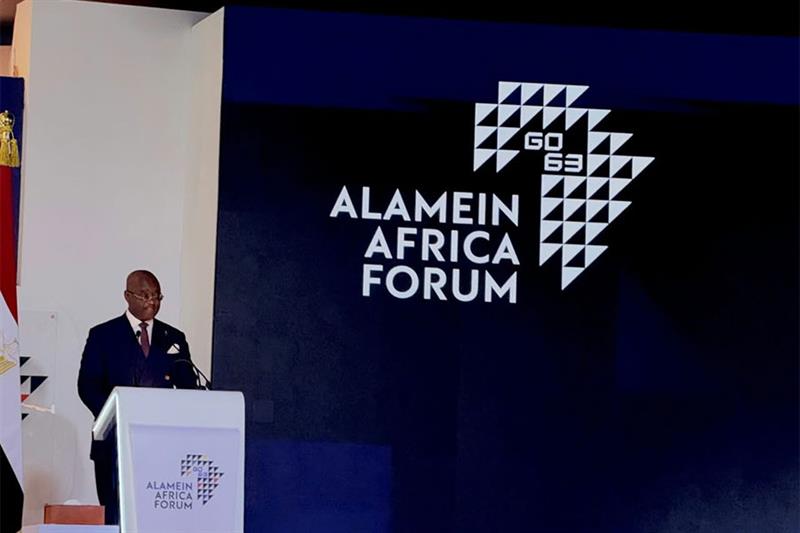

Speaking at the opening ceremony of the Alamein Africa Forum 2026 in New Alamein, Elombi said the question facing Africa was not merely one of credit ratings, but of ownership and the continent’s ability to control and direct institutions it has built itself.
“This Bank is yours. Defend it as you built it — without asking for anyone’s permission,” Elombi told African heads of state and government officials attending the forum.
Elombi said Afreximbank, established in 1993 by African governments, was created during the continent’s debt crisis, when African economies faced shrinking trade finance and increasing external conditionality.
“You did not accept that verdict. You created Afreximbank — a bank owned by Africans, governed by Africans, answerable to Africans,” he said.

Egypt’s role
Elombi paid tribute to Egypt’s longstanding support for the bank, recalling that Egypt signed the agreement providing Afreximbank with a home in Cairo in August 1994, when the institution was barely a year old.
He also highlighted Egypt’s role in hosting the first Intra-African Trade Fair and its decision to host the event again in 2023 at short notice.
He noted that Afreximbank’s new global headquarters is currently being developed in Egypt’s New Capital.
“Mr. President, thank you,” Elombi told Egyptian President Abdel Fattah El-Sisi, who attended the opening ceremony.
Afreximbank is a partner in convening the Alamein Africa Forum alongside Egypt’s Ministry of Foreign Affairs and the African Union Development Agency (AUDA-NEPAD).
Elombi said the forum reflected the belief, shared with Egyptian Foreign Minister Badr Abdelatty, that peace and security can be strengthened when political diplomacy is accompanied by meaningful economic exchanges.
Afreximbank’s crisis response
Elombi stressed that Afreximbank’s response to crises has become a defining feature of the institution.
He cited the bank’s approval earlier this year of a $10 billion Gulf Crisis programme following disruptions to shipping routes, fuel markets and fertilizer supplies.
He also recalled Afreximbank’s interventions during the COVID-19 pandemic to provide liquidity and support vaccine financing, as well as its $4 billion programme launched following the outbreak of the Russia-Ukraine war to address the impact of rising food and energy prices.
“When Africa needs its bank, its bank must be there,” he said.
According to Elombi, the bank’s shareholders’ funds currently stand at almost $9 billion, while its net income increased by 30 percent in the first half of 2026. He said Afreximbank’s balance sheet is now roughly six times larger than it was a decade ago.
He added that African shareholders injected nearly $300 million in fresh equity into the bank in 2025, while $226 million had been paid so far this year, with a further $300 million expected.
Criticism of credit-rating methodologies
A major part of Elombi’s address focused on international credit-rating methodologies and what he described as inadequate recognition of the actual financial commitment made by African shareholders to Afreximbank.
He criticized criteria that, he said, give greater weight to development banks whose shareholders include large, highly rated sovereigns that are not borrowers from the institutions.
Elombi argued that Afreximbank’s African shareholders have demonstrated their commitment through actual cash injections rather than merely callable capital commitments.
“We do not have to guess about you. You have answered, again and again, in cash,” he said, referring to African governments’ capital contributions to the bank.
He argued that credit-rating frameworks should take into account the bank’s ownership structure, track record and countercyclical role rather than judging it solely against institutions established under a different historical model.
“We are not asking to be judged kindly. We are asking to be judged accurately,” Elombi said.
He pointed to S&P’s decision this year to rate Afreximbank investment grade after returning to assess the bank for the first time in more than a decade, saying the rating agency recognized the bank’s role as a countercyclical lender supported by shareholders that continue to inject capital.
Ghana intervention
Elombi also cited Afreximbank’s support for Ghana during its recent economic and debt crisis as an example of the bank’s role as an African-owned institution.
He said Afreximbank continued financing Ghana at a time when other institutions had reduced or cut their exposure to the country.
Elombi argued that the bank’s intervention demonstrated the importance of having an African financial institution capable of making decisions without seeking approval from actors outside the continent.
He criticized the subsequent treatment of Afreximbank in the context of Ghana’s debt restructuring, arguing that the bank should not be treated as a private lender simply because it provided financing to an African country during a crisis.
Call for stronger African financial architecture
Elombi urged African governments to continue capitalizing their financial institutions, defend the legal commitments underpinning them and strengthen cooperation among the continent’s multilateral financial institutions.
He referred in particular to Afreximbank’s preferred creditor status under its founding treaty, urging shareholder governments to uphold the commitments they made when establishing the bank.
He also called for greater unity among African multilateral financial institutions, citing the Alliance of African Multilateral Financial Institutions as an example of how the continent can respond collectively to challenges affecting its institutions.
Looking ahead, Elombi called for the development of a stronger African financial architecture capable of mobilizing the continent’s savings, financing intra-African trade, supporting African businesses and investing in infrastructure.
“A continent of 1.5 billion people cannot depend indefinitely on financial systems designed elsewhere, many decades ago, that do not speak to our realities,” he said.
He stressed that Africa was not seeking to replace the global financial system, but wanted its institutions and interests to have a stronger place within it.
“We are not seeking to replace the global system. Rather we are insisting on a place within it that reflects our weight, our capital, our markets and our ambitions,” Elombi said.
Concluding his address, the Afreximbank president urged African leaders to continue supporting and defending the institutions they had created.
“When the world retreats, Africa must not,” he said.