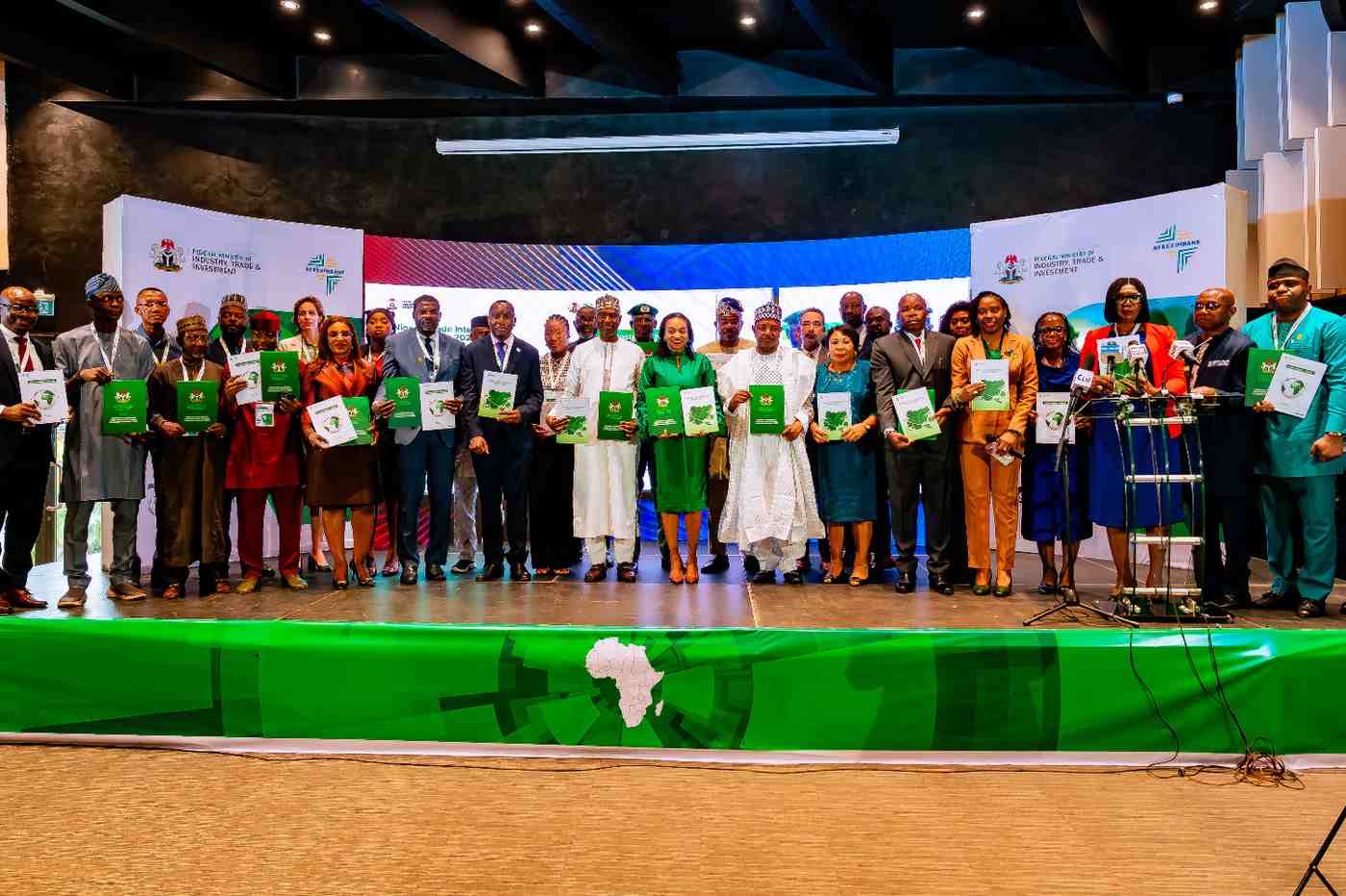
FMITI, Afreximbank Hold Summit on AfCFTA Simplified

KEYNOTE SPEECH
DR. JUMOKE ODUWOLE, MFR
HONOURABLE MINISTER OF INDUSTRY, TRADE AND INVESTMENT
AfCFTA P3 Summit Protocol
-
It is my pleasure to officially welcome you to the Inaugural AfCFTA Public–Private–Press (P3) Summit.
-
This Summit is designed to enable a deeper understanding of the AfCFTA framework and to mobilise the whole-of-economy effort toward achieving Item 7 of Mr. President’s Renewed Hope Agenda.
-
This year began with global headwinds — from tariff tensions to shifting economic dynamics. In this uncertain climate, Nigeria has recorded deeper levels of economic diversification, stronger industrial capacity, and unprecedented opportunities for our businesses across the continent.
-
As we move towards the end of this year, this Summit is our platform to align our vision. We must ensure that our collective efforts going forward are intentional and coordinated toward achieving our economic agenda.
-
The African Continental Free Trade Area represents one of the most ambitious economic integration efforts in the world:
-
a. It is the largest free trade area in the world by number of participating countries, with a combined GDP of approximately $3.4 trillion.
-
b. It is a lively market of 1.4 billion people, the majority of whom are young.
-
c. It is an economic arrangement that ensures African producers, investors, traders, and workers can profitably convert opportunity to prosperity.
The key argument for the AfCFTA is simply that Africa retains more value when she trades with herself. By implication, our economic ambitions are inseparable from our participation in the AfCFTA market.
-
-
The AfCFTA Agreement came into force in May 2019 with ratification by 22 African Union member states. Nigeria ratified the AfCFTA Agreement in 2020. Today, 48 African Union member states — 87% of all African countries — have ratified this Agreement. Our One African Market is coming to life.
-
Nigeria is Africa’s champion of trade-led regional integration. Many of the anchor continental instruments were conceived and birthed here. These include:
-
The Lagos Plan of Action (1980)
-
The Treaty Establishing the African Economic Community (1991), also known as the Abuja Treaty
It was also here in Abuja that the negotiations for the AfCFTA Agreement were concluded in 2017.
-
-
The Federal Ministry of Industry, Trade and Investment, and the AfCFTA Central Coordination Committee, under my leadership, will continue to position Nigeria as a successful and dynamic leading player in the AfCFTA market.
-
Throughout 2025, we have worked relentlessly to ensure Nigeria delivers on her responsibility and maximises the opportunities in the AfCFTA.
-
Allow me to share with you key milestones achieved this year — 2025:
Milestones Timeline
-
January: We hosted the Secretary-General of the AfCFTA Secretariat to firmly indicate Nigeria’s readiness and willingness to be a leading player in the One African Market.
-
February:
-
Mr. President was commended at the 38th African Union Summit for advancing digital trade across the continent.
-
Nigeria was designated as a Co-Champion of the AfCFTA Protocol on Digital Trade by the African Union Assembly of Heads of State and Government.
-
-
March:
The Federal Ministry of Industry, Trade and Investment inaugurated the AfCFTA Central Coordination Committee (CCC) — a whole-of-government and whole-of-economy structure that brings together key public and private stakeholders to effectively implement the AfCFTA and increase our levels of intra-African trade. -
April:
-
Following Mr. President’s approval, Nigeria gazetted its Provisional Schedule of Tariff Concessions for Trade in Goods.
This allows Nigeria to apply preferential and reduced tariffs on goods originating in Africa, while Nigerian-made goods receive similar treatment across the continent. -
We also conducted the first-ever national mapping of digital service firms to better understand their target countries and support market access.
-
-
(Continuation of April milestones)
Mapping of digital services completed to guide support strategies. -
May:
We presented Nigeria’s Call to Action at the inaugural AfCFTA Digital Trade Forum in Lusaka, Zambia. -
Nigeria also won the hosting rights for the second edition of the Forum, to be held in Lagos in 2026.
-
For trade in goods, FMITI launched a dedicated Exports Air Cargo Corridor to East and Southern Africa, in partnership with Uganda Airlines, the Nigeria Customs Service, and UNDP.
-
This Corridor reduced cargo rates by 50%–75%, compared to prevailing market rates.
-
We further published a Market Intelligence Tool to guide exporters of cosmetics, agro-processed products and textiles into East and Southern African markets, in collaboration with UNDP.
-
July:
Nigeria became the first African Union member state to conclude and publish a five-year review of AfCFTA implementation, as mandated by Article 28 of the Agreement.
We formally presented this review at the Domestic Investors Summit in this hall. -
This review provides honest and objective self-reflection on frictions, challenges, and successes.
Its outcomes will inform the technical exercises to be conducted today and tomorrow by the CCC, the Private Sector, and the Press. -
August:
We commenced work with the AfCFTA Secretariat to identify pilot countries for the DigiPass Project, to operationalise the continental digital market and secure a meaningful share in the Fourth Industrial Revolution. -
September:
Nigeria successfully won the bid to host the Intra-African Trade Fair 2027, in collaboration with Afrexim Bank, the African Union Commission, and the AfCFTA Secretariat. -
October:
We submitted Nigeria’s Schedule of Specific Commitments for Trade in Services to the ECOWAS Commission.
This Schedule will be forwarded to the African Union Assembly of Heads of State and Government.
From 2026, we aim for Nigerian service producers to expand across Africa under preferential AfCFTA terms. -
October (continued):
We convened the first AfCFTA Regional Digital Roundtable with Egypt, Ghana, Kenya, Rwanda, and South Africa — identified from our April mapping as priority markets. -
We also established a Regulators’ Working Group with these countries to facilitate market access for Nigerian digital service firms.
-
November:
The Federal Executive Council approved the ratification of the AfCFTA Protocol on Digital Trade, affirming Nigeria’s readiness for full implementation. -
It has been a busy year, and I would like to pause to celebrate and commend the Federal Ministry of Industry, Trade and Investment, under the leadership of the Permanent Secretary, alongside the Trade Department and the Office of the Honourable Minister.
I also appreciate the active members of the AfCFTA CCC, and the leadership and teams of the Nigeria Customs Service and the Nigeria Immigration Service for their cooperation and collaboration. -
Your hard work is a testament to our shared commitment to delivering meaningful progress for our nation.
-
I also appreciate all our partners on this AfCFTA journey — AfCFTA Secretariat, Afrexim Bank, UNDP, ODI, and GIZ.
Looking Ahead
-
Let me now invite you to envision our future in the AfCFTA market.
-
We must ask ourselves a few simple questions:
-
What does the AfCFTA mean to Nigerians — to our businesses, workers, investors, and communities?
-
How will the AfCFTA positively contribute to Nigeria’s economy?
-
-
Your Excellencies, distinguished guests, ladies and gentlemen, we will collectively answer these questions over the next two days.
-
For the public sector, government institutions will clearly state their functions and responsibilities in AfCFTA implementation.
They will also develop a Barometer — a scorecard for evaluating the performance of every institution in the CCC. -
Similarly, the private sector will articulate the pillars of our national AfCFTA market strategy.
This is a listening administration, and we welcome your perspectives on how we can support you to scale your trade and operations across Africa. -
Allow me to make a few suggestions to inform your deliberations.
-
Nigeria must, as a matter of urgency, diversify her goods export basket.
Intra-African trade records higher levels of value-added products than trade with other regions.
To succeed, we must produce and trade higher levels of processed and industrial goods. -
Likewise, the sophistication of Nigeria’s service sectors must be better reflected in our trade dynamics.
In 2024, Nigeria’s total trade in services stood at $16.49 billion, but only 20% was exported.
Services contribute less than 10% to our export basket — we must scale our services exports rapidly and strategically. -
We must align our investment regulatory architecture with the continental framework to attract and retain high-quality investments.
-
We must also identify the key investments — within and outside Nigeria — that will give our businesses the capacity and competitiveness to trade across Africa.
-
With the Press, we hope to begin a collaborative journey to ensure every Nigerian understands the AfCFTA.
Our messaging must be consistent and constructive. -
We also hope to better capture the experiences of Nigerian businesses navigating the AfCFTA.
-
I hope that when we meet in 2026, we will have even greater successes to celebrate — together.
-
Finally, let us work together — Public Sector, Private Sector, and the Press, in collaboration with our Partners — to build a One African Market that is Made, Powered, and Led by Nigeria.
-
As a first action to launch our new tripartite collaboration, I invite you to unveil:
-
a. Two new Trade Intelligence Tools developed by the Ministry
-
b. The National Action Plan Framework of the CCC
-
Thank you, and God bless the Federal Republic of Nigeria.