Kagame Calls For African Unity, Economic Self-Determination at Africa CEO Forum 2026
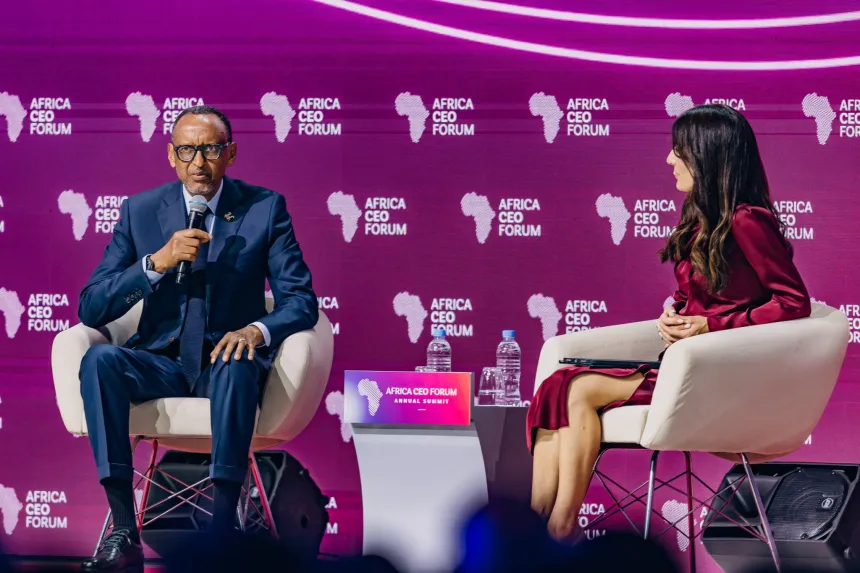

President Paul Kagame has used a high-level fireside chat at the Africa CEO Forum 2026 in Kigali to question global power dynamics, defend Africa’s right to protect its interests, and call for stronger continental unity in shaping economic decisions.
The forum, held at the Kigali Convention Centre, has brought together heads of state, CEOs, investors, and policymakers under the theme “The Scale Imperative: Why Africa Must Embrace Shared Ownership.”
Kagame: Sanctions reflect difficult global power calculations
Speaking in conversation with Eleni Gabre-Madhin, President Kagame reflected on the trade-offs behind sanctions and external pressure, describing them as part of broader geopolitical calculations that often place African countries at a disadvantage.
“Sanctions are meant to hurt people, so in a way, we are hurt. But I think we would be hurt more by not doing what we are doing, so it’s always a calculation. It’s not difficult to say no; in fact, it costs more to say yes to the wrong things. But all these things come to pass,” he said.
He went further, arguing that global political and economic decisions are often influenced by power and interest rather than principle.
“Sometimes sanctions are just applied in a case of one who provides less than the other. So it was in the favor of the highest bidder. When somebody knows they will extract more from a certain place, they will be more favorable to that place, even if they are the ones in the wrong,” Kagame said.
He added that global powers are increasingly open about their influence.
“The powers that be are holding a whip in their hands, using a stick to beat up whoever they want to beat up. They’re no longer even hiding it. It’s just in the open,” he stated.
Africa must defend its interests collectively
Kagame urged African countries to move beyond passive responses and instead build stronger collective mechanisms to protect their strategic interests, particularly in the face of global competition over resources.
“These powers you see that come here lecturing people on democracy, human rights, and they are doing it with one arm and with the other, they are just taking away everything that people own,” he said.
He stressed that Africa’s challenge is not lack of knowledge or discussion, but execution and unity.
“The question is not what the world is doing to Africa. The question is why Africa is still unable to fully defend its own interests despite its enormous strategic advantages. We need to come together and do something about it. There is a lot we know, there is a lot we talk about, but we need to do a lot more,” Kagame added.
“Saying no is not the problem” — Kagame on policy choices
The President argued that African countries must be willing to reject unfavorable agreements, even when doing so comes at a short-term cost.
“It is not so difficult to say no. In fact, it costs more to say yes to the wrong thing,” he said.
He also cited examples of African countries pushing back against unbalanced resource-related deals, noting that such resistance reflects a growing awareness of long-term national interest.
Kagame acknowledged that sanctions and external pressures are painful but insisted they should not dictate national decisions.
“Even in a worse situation, I never capitulated. This is not a bad situation as such. Well, it hurts, absolutely. And that’s what it is meant to do… But I think we would be hurt more by not doing what we are doing,” he said.
Africa urged to rethink value creation and resource control
The discussion also reflected broader concerns raised at the forum about Africa’s position in global value chains, particularly in sectors such as minerals and agriculture, where the continent exports raw materials but captures only a small share of final value.
Kagame argued that such pressures should push Africa toward deeper self-reliance and industrialization rather than dependency.
“These pressures… are not entirely bad. I think they force Africa to look within,” he noted.
RDB calls for execution and regional integration
Speaking at the forum, Jean-Guy Afrika, CEO of the Rwanda Development Board, emphasized that Africa’s transformation depends on execution, stronger partnerships, and reduced barriers to investment.
He said the continent must move from ambition to delivery by building predictable markets and improving cross-border cooperation.
“The Africa CEO Forum has become a platform where Africa’s public and private sector leaders come together to shape a common agenda for growth, investment, partnership and execution,” he said.
Outlook: A push for shared ownership
The forum has attracted more than 2,000 to 2,800 participants from over 75 countries, including heads of state, CEOs, investors, ministers, and development finance institutions.
As discussions continue, the 2026 edition is expected to focus on strengthening Africa’s bargaining power in global markets, improving value addition, and accelerating industrialization through shared ownership and coordinated action.
Analysts say the strong messaging from Kigali underscores a growing push for Africa to redefine its role in the global economy—not as a passive supplier of raw materials, but as an active architect of its own economic future.