MC14 opens in Yaoundé with call to reinvigorate WTO in time of crisis
The WTO's 14th Ministerial Conference (MC14) in Yaoundé, Cameroon, opened on 26 March with concerns about geopolitical strife and the future of the organization weighing on WTO members. Nevertheless, Director-General Ngozi Okonjo-Iweala said she was hopeful the gathering of trade ministers would find the political will to overcome differences and advance work on important topics on the MC14 agenda.
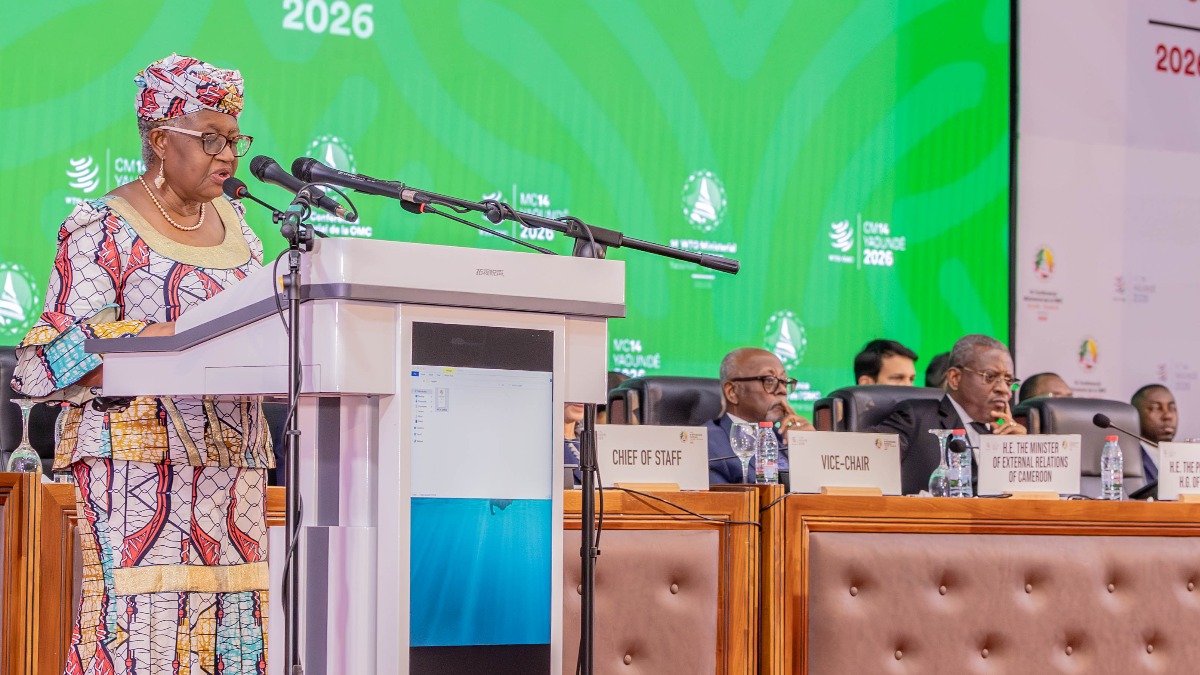

In her remarks to the Opening Session of MC14, DG Okonjo-Iweala acknowledged that the 26-29 March gathering was taking place at a difficult moment for world commerce and the multilateral trading system.
"We cannot deny the scale of the problems confronting the world today," the Director-General said. "It is no secret that the world trading system is experiencing the worst disruptions in the past 80 years."
"The world order and multilateral system we used to know has irrevocably changed," she added. "We will not get it back."
The organization therefore "must look to the future. That means figuring out what worked well in the old order, so we can keep it and build on it. It means figuring out what did not work well, so we can repair it. And it also means identifying the gaps in the renewed order we are shaping, so we can close them."
The Ministerial Conference, normally held every two years, is the highest decision-making body of the WTO. More than 2,000 trade officials, including more than 80 trade ministers, are expected to attend the four-day event, the second time a Ministerial Conference has taken place in Africa.
In welcoming the attendees, Luc Magloire Mbarga Atangana, Cameroon's Minister of Trade and the Chair of MC14, said the WTO has served as the cornerstone of trade and has helped build stability, predictability and transparency in international trade. It has also contributed to improving living standards, expanding economic opportunities and integrating economies into shared global systems.
Nevertheless, the organization must evolve and become more agile and stronger to address issues such as fragmentation and changing trade dynamics, he said. "Reform must lead to a stronger, more effective WTO able to respond to challenges of today and restore confidence in the multilateral trading system," he declared.
The Opening Session included a celebration of the entry into force of the Agreement on Fisheries Subsidies. Adopted at the WTO's 12th Ministerial Conference (MC12) in June 2022, the Agreement entered into force on 15 September 2025 after two-thirds of WTO members submitted their instruments of acceptance.
The Opening Session also heard a special intervention from Türkiye's Minister of Trade Ömer Bolat, who said his country would no longer object to the incorporation of the Investment Facilitation for Development Agreement (IFDA) into the WTO legal framework as a plurilateral agreement.
The Director-General acknowledged the difficult task facing the gathered ministers at what she previously described as a "turning point" meeting. Challenges facing the ministers include considering a work programme for advancing discussions on WTO reform, finding common ground on the WTO's e-commerce work programme and extension of the e-commerce moratorium on customs duties, producing guidance on delivering negotiated solutions on agriculture trade post-MC14, reaching decisions aimed at supporting the further integration of least developed countries (LDCs) into the multilateral trading system, considering the incorporation of the IFDA into the WTO rulebook alongside existing plurilateral agreements, and others.
"We have a work-filled and difficult four days ahead of us," she declared. "It is now really up to you members to decide whether you want the organization to continue or you want to pull it apart.
"On my side, I am full of hope," she added. "Hope that collaboration and cooperation will be the order of the day. Hope that we shall all see the bigger strategic issues at stake for our organization and the people we are here to serve, and deliver tangible results. Hope that we will have the courage, in Kwame Nkrumah's famous phrase, to "face forward."
The full text of the Director-General's opening remarks is available here.
MC14 work programme
A central focus at MC14 is the issue of WTO reform, which has been identified as a top priority by many members.
Four ministerial sessions on WTO reform will take place on 26-27 March on the following topics:
- Ministerial conversation on foundational issues on the WTO, including its principles;
- Breakout session on decision-making and past mandates;
- Breakout session on development; and
- Breakout session on level playing field issues.
Each session will be guided by a minister-facilitator whose role is to foster dialogue and forward-looking exchanges that will help guide substantive work beyond MC14. Trade ministers from Norway, New Zealand, the Republic of Korea, the United Kingdom, Singapore and Costa Rica will serve as minister-facilitators for the discussions.
The discussions will conclude with a WTO reform transparency plenary session on the evening of 27 March. The first part of the session will be dedicated to hearing the reports from minister-facilitators on the breakout sessions. During the second part of the session, ministers will have an opportunity to express their views on adopting the draft Yaoundé Ministerial Statement on WTO Reform and Work Plan prepared by the facilitator for the WTO reform talks, Ambassador Petter Ølberg of Norway.
Background on the WTO reform discussions is provided in this MC14 Briefing Note. More information is also available on the dedicated WTO reform webpage.
Ministerial sessions
On 28 March, dedicated MC14 ministerial sessions will take place on the following issues:
- Dispute settlement reform update;
- Fisheries subsidies;
- Incorporation of the Investment Facilitation for Development Agreement (IFDA) into the WTO framework;
- E-commerce work programme and moratorium;
- Agriculture; and
- Development (including issues related to least developed countries, or LDCs)
Under each topic, ministers will engage in exchanges to provide political direction for work ahead and address unresolved issues to finalize specific decisions, ministerial guidance, or other outcomes. Each discussion will be guided by a minister-facilitator, with trade ministers from the Philippines (fisheries subsidies), Saint Vincent and the Grenadines, and Nigeria (IFDA), Jamaica (e-commerce work programme and moratorium), Pakistan (agriculture) and Cameroon (development, including LDC issues) serving as the minister-facilitators.
On the final day of the conference, the MC14 Chair and the Director-General will convene an informal heads of delegation meeting where members will hear reports from minister-facilitators on the discussions in their respective areas, including any outreach conducted. Ministers will also use this occasion to consider any potential outcomes that may be presented for approval or endorsement during the formal closing session.
Immediately after this meeting, the Ministerial Conference will convene in formal mode to take any necessary action, including gavelling final decisions. Following this, the Director-General and the MC14 Chair will deliver their closing statements.