Morocco’s Argan Oil Industry Targets China’s New Zero-Tariff Market
While the United States has moved toward higher tariffs under President Donald Trump’s protectionist policies, China has been opening its market to African nations.
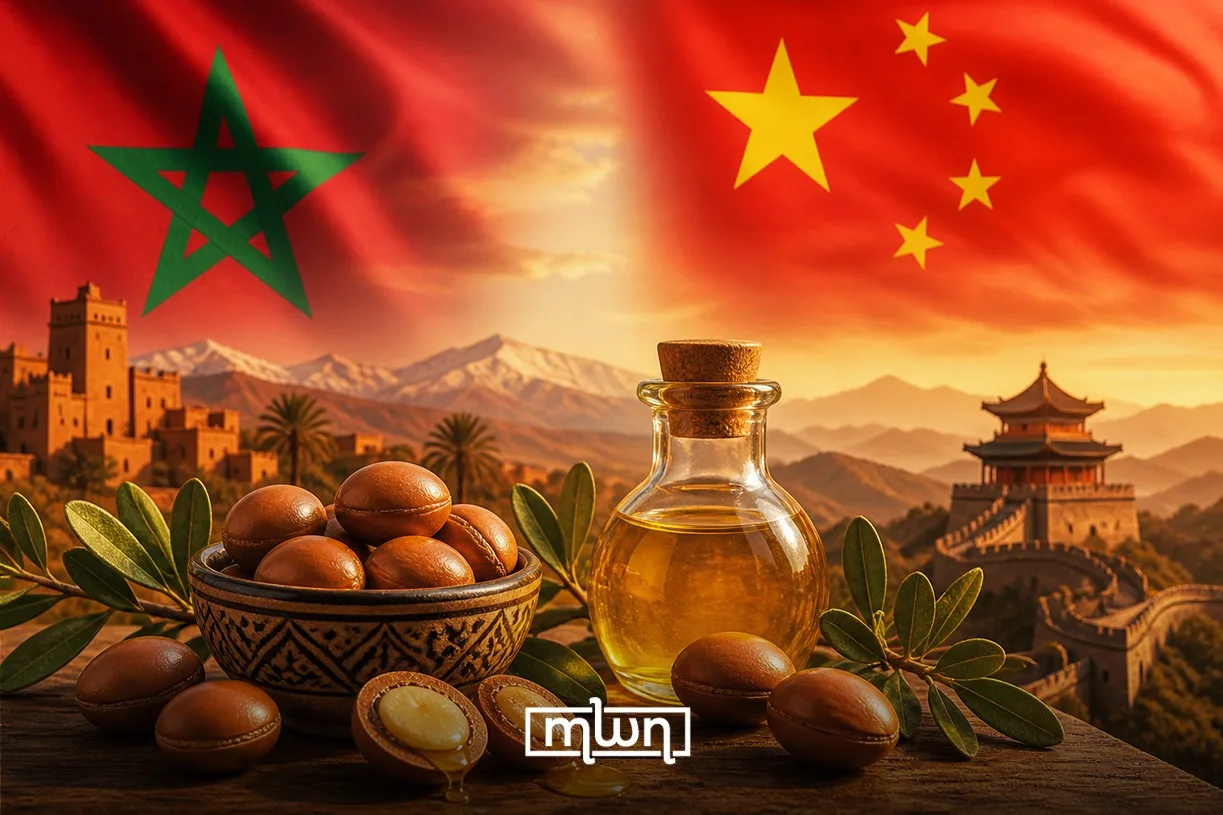
Marrakech – Morocco’s argan oil producers are setting their sights on one of the world’s largest consumer markets. China’s zero-tariff policy for 53 African countries, which took effect on May 1, has opened a new trade corridor that could widen the reach and boost the economics of Morocco’s centuries-old argan industry.
According to a report by CGTN, producers in southern Morocco are positioning the sector for what they hope will be a major commercial breakthrough.
The policy eliminates import duties on goods from African nations that maintain diplomatic ties with Beijing, making China the first major economy to unilaterally grant full tariff exemption to the continent. Morocco, as a leading exporter of argan oil, stands to benefit directly.
Argan oil is extracted from the kernels of the argan tree, native to Morocco’s arid southwest. The production process remains labor-intensive. Fruit is dried under the sun, peeled, crushed, and ground before oil is extracted.
Cooperatives run by Amazigh women in regions surrounding Agadir, Essaouira, and Taroudant carry out much of this work, blending traditional hand-cracking techniques with modern electric machinery.
“Demand for argan oil is rising, both for food and beauty products. We produce it using a mix of traditional methods and modern electric extraction machines,” said Alhanid Boubaker, an argan oil producer, in the CGTN report.
Known globally as “liquid gold,” argan oil straddles two distinct markets. At home, it is used in cooking and traditional medicine. Abroad, it has become one of the most sought-after ingredients in the cosmetics industry, valued and prized for its anti-aging and restorative properties.
Locally, a liter sells for between $30 and $50. On international shelves, packaged in luxury cosmetic bottles, the same quantity can fetch up to $250. Morocco controls more than 90% of the world’s commercial argan oil supply.
“Despite climate challenges, argan oil has preserved its quality. Customer loyalty remains strong, with repeat buyers returning regularly, both in the domestic market and in export markets,” said Mohamed Aït Haj, an argan oil trader.
The zero-tariff policy arrives at a time of broader trade realignment. While the United States has moved toward higher tariffs under President Donald Trump’s protectionist policies, China has been opening its market to African nations. In the first quarter of 2026, China-Africa trade reached $94.56 billion, up 23.7% year-on-year.
For the argan sector, the timing aligns with strong growth projections. Industry data from Grand View Research projects Morocco’s argan oil market will grow from $90.1 million in revenue in 2025 to $212.2 million by 2033, at an annual growth rate of 11.4%.
But expansion carries environmental risks. Years of drought, overgrazing and water scarcity have reduced Morocco’s argan forests, threatening the ecosystem that sustains both local livelihoods and export revenues.
“Surging exports of argan oil, fuelled by demand from China’s cosmetics sector, are increasing pressure on this vital resource,” said environmental expert Mustapha Aissat. “That makes conservation efforts more urgent, alongside targeted government policies.”
University professor Hanae Aitoutouhen framed the trade opening in broader terms: “Adjusted tariff policies could unlock new export opportunities, boosting the sector while generating shared economic benefits for both sides.”
To address the environmental strain, Moroccan authorities have launched several initiatives under the “Génération Green” strategy. The government plans to plant 50,000 additional hectares of argan trees by 2030, aiming to bring the total cultivated area to 400,000 hectares.
A key component is the DARED project, funded by the Green Climate Fund at a cost of $49.2 million, which targets the plantation of 10,000 hectares of modern argan orchards across the regions of Souss-Massa, Marrakech-Safi, and Guelmim-Oued Noun.
The project, overseen by Morocco’s National Agency for Oasis and Argan Zone Development (ANDZOA), benefits an estimated 26,000 farmers.
Morocco’s existing argan forest covers roughly 830,000 hectares and supports more than 500 cooperatives employing around 10,000 women.
The challenge now is whether growth in exports can be sustained without further degrading the resource base that makes the industry possible.