Supply Shocks from Hormuz Crisis ''Is Not Over'' Yet - IEA

An unprecedented shock to the system
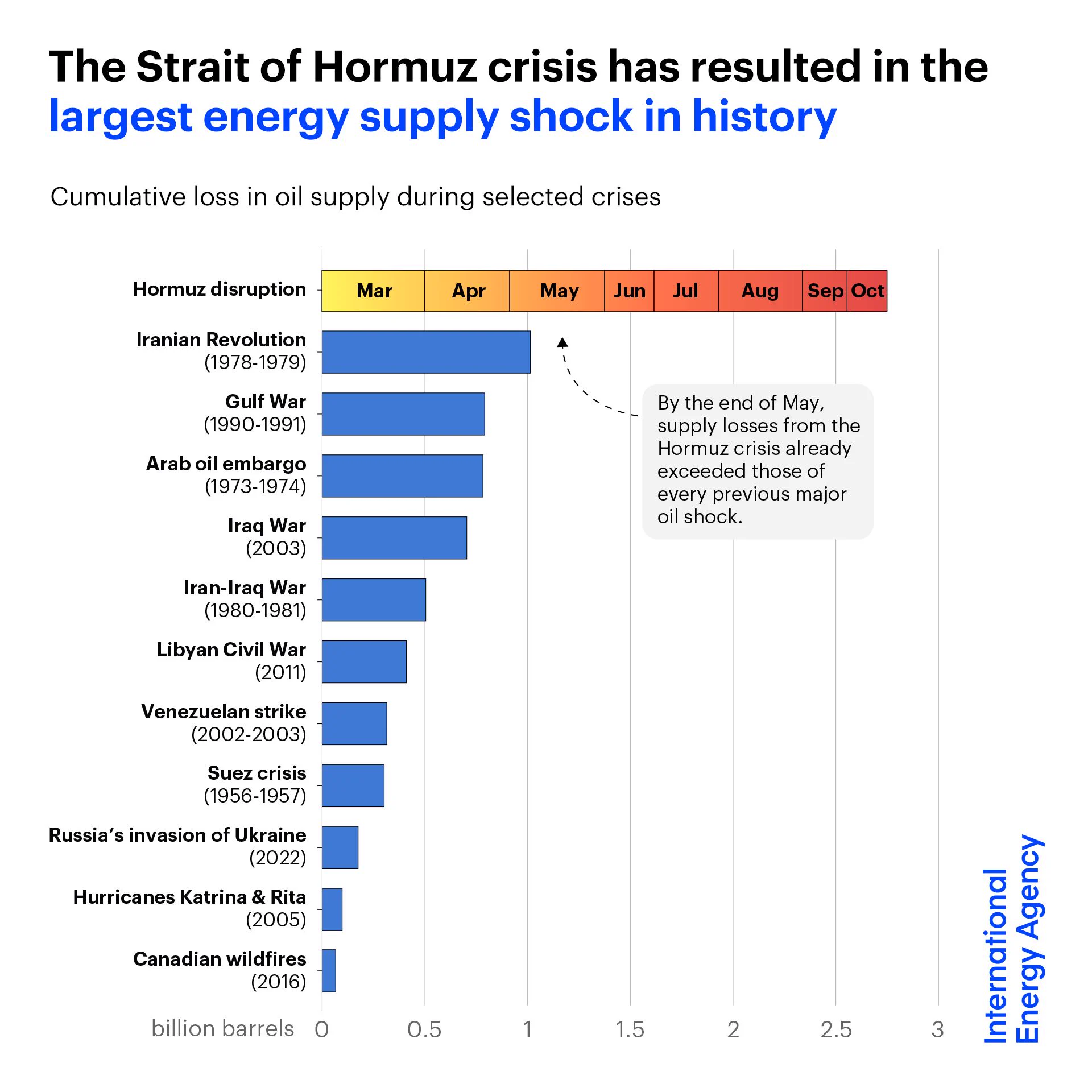
The disruption to energy flows through the Strait of Hormuz in 2026 has been the largest energy supply shock that the world has faced and – as of November – it is not over. The energy system has shown considerable resilience in the face of cumulative losses of 2.8 billion barrels of oil and 60 billion cubic metres (bcm) of gas supply from the Gulf, but increasingly it is falling to consumers – and high prices – to absorb the impact as other buffers are run down. Exports from the Gulf have ebbed and flowed in response to changes in the security situation. Market impacts have been heightened by risks affecting transit through the Red Sea and by disruptions to Russian supply as Russia’s full-scale invasion of Ukraine entered its fifth year. Supplies of diesel, the workhorse of the global economy, have come under extreme pressure, with prices hitting record levels above USD 200/barrel.
The effects of the 2026 crisis have reached all corners of the world: three-quarters of the world’s population live in oil- and gas-importing countries, and more than 4 billion people live in countries that depend on the Strait for more than 30% of their oil supplies. The crisis has taken a heavy toll in the Middle East, with the energy effects including damage to infrastructure, lost export revenues and fuel shortages in some countries. Developing economies in the Asia Pacific region and in Africa have been among the worst-affected importers. Prior to the crisis, around 80% of the oil and almost 90% of the liquefied natural gas (LNG) passing through the Strait were destined for Asia.
The 2026 crisis compounds a broader sense of fragility in energy markets, amid geopolitical tensions, rising climate risks, cyberattacks and other malicious activity affecting energy infrastructure. August 2026 was the hottest month globally on record, and a strong El Niño could add to weather-related strains. High energy prices and shortfalls in fertiliser supply are creating hazards for food security. Emissions of carbon dioxide (CO2) and air pollutants from fuel combustion remain dangerously high. Energy geopolitics are fracturing, and trade restrictions are on the rise. Trust is in short supply. Each vulnerability deepens the others.
This is also a time of profound structural change, as the world moves deeper into the Age of Electricity with a cost-competitive suite of low-emissions technologies to hand. Electricity today accounts for around 23% of final energy consumption, but it is the key source of energy for sectors accounting for over 45% of the global economy. The energy sector is starting to feel the potentially transformative impacts of artificial intelligence (AI). And, for the first time on record, a renewable source of energy, solar photovoltaics (PV), contributed not only the largest share of the increase in global power generation in 2025 but also a larger share of the growth in overall energy demand than any other source.
A range of possible energy futures
Previous energy shocks, from the 1970s onwards, all left lasting marks on the energy world: this one will too, and the longer the crisis lasts, the deeper these marks will be. It is not yet clear what a durable resolution in the Middle East might look like, and it is too soon to ascertain the lessons that different countries will draw. But some general conclusions are clear, chief among them being a reinforced focus on energy security and affordability as guiding principles for energy decision making. In many cases, especially among fuel importers, these concerns are closely aligned with the push for clean energy transitions.
A central question for this Outlook is how the 2026 crisis might alter policy preferences, risk perceptions and the mix of fuels and technologies that the world uses to meet our energy needs. There can be no single answer to this question, which is why we have multiple scenarios and cases. The Current Policies Scenario (CPS) is based on energy policies and regulations that are already firmly in place and offers the least scope for change to pre-existing trends. By considering specific policy measures that have formally been put forward but not yet adopted, the Stated Policies Scenario (STEPS) incorporates more reactions to the crisis. These scenarios assume a continued easing of constraints on Gulf exports and sufficient stability to allow for unimpeded transit through the Strait by the end of 2027.
The longer the crisis goes on and risks to oil and gas supply from the Middle East persist, the more likely it is that policy and market responses will extend beyond those in the CPS and STEPS. The Additional Response Case (ARC) explores this possibility: it is grounded in supply- and demand-side actions that are under consideration by governments, even if they are yet to be turned into formal policy proposals, and asks what would happen if they were implemented. The Low Hormuz Case (LHC) asks whether the energy world could manage without transit through the Strait.
Alongside these exploratory scenarios and cases, the Net Zero Emissions by 2050 (NZE) Scenario offers a normative perspective on the future, mapping out a way to bring down emissions to net zero by mid-century. It provides a global pathway towards the goal of limiting global warming to 1.5 °C, but not the only possible one.
A common starting point: rising demand for energy services
In any vision of the future, higher incomes and population mean a rising requirement for the services that energy provides, including mobility, heating, cooling and computing power. These needs rise modestly in advanced economies and more rapidly (albeit slowing over time) in China. They grow fastest in other emerging and developing economies, home to two-thirds of the world’s population and to an increasing share of the world’s industrial activity. India and Southeast Asia see the largest overall increase in energy needs, followed by Latin America, the Middle East and Africa. In a world of rising incomes and rising temperatures, there is a striking increase in demand for cooling. In emerging market and developing economies outside China, 85% of households are exposed to high temperatures, but less than 20% of these households currently have an air conditioner. Already today, for the first time in energy history, global cooling needs are overtaking those for heating. The underlying need for energy services is broadly similar in all our scenarios and cases, but they differ – sometimes dramatically – in the combinations of fuels and technologies that are deployed to meet these needs, illustrating the scope for policy action.
How could the 2026 crisis reshape the energy outlook?
Responses to the crisis vary across countries, but there are some common themes:
-
Diversification reinforced as a key policy preoccupation across multiple dimensions, including suppliers, routes, energy mixes and technology supply chains.
-
A stronger preference for domestically available resources, which naturally vary by country.
-
A push for faster electrification in the Age of Electricity.
Application of these levers has implications for demand and trade patterns for oil and natural gas, the two fuels at the centre of the crisis. In the CPS, demand for both oil and gas continues to rise. While electrification, efficiency and biofuels cut passenger car oil use to 2035, this is more than offset by a combined increase of 5 million barrels per day (mb/d) for petrochemicals, aviation and heavy trucks. Natural gas use grows strongly, backed by a wave of new LNG supply. In the STEPS, the pace of structural change is faster. Oil demand levels off at around 103 mb/d by 2030 before entering a slow decline; natural gas demand rises to the mid-2030s before plateauing. In the ARC, in which security risks and uncertainties are assumed to persist for longer, oil use starts to fall earlier and by 2035 is more than 4 mb/d lower than in the STEPS. Global gas demand grows but at a slower pace than in the STEPS, and demand for LNG is hit. In the NZE Scenario, meeting stringent emissions goals requires much more rapid substitution of oil and gas, putting their use into earlier and faster decline.
Diversification: The first golden rule of energy security
Confidence in the Strait of Hormuz has been shattered and additional bypass projects are moving ahead, but it will not be easy or quick to manage without oil shipments through this strategic waterway. In the case of oil, around 7 mb/d of new pipeline projects are under construction or under consideration that enhance the ability of Gulf producers to reach international markets without going through the Strait. Building them would require an estimated USD 40 billion, adding around USD 2 to the cost of a barrel of oil exported from the Middle East. If all these projects are completed, non-Gulf producers step up output, and importers bring down demand as in the ARC, then our Low Hormuz Case reduces the need for transit through the Strait to 2 mb/d by 2035. But this finding comes with two important qualifications. As already seen in 2026, if the Middle East is unstable, then alternative routes for Gulf exports are likely to be vulnerable too. And while it is possible to diversify away from the Strait of Hormuz over time, the same does not apply to the Middle East as a whole. Even in this extreme case, the Middle East remains the largest exporter of oil to international markets, underlining that supplies from this region are still vital for oil markets and security.
The priority attached to diversification and additional layers of fuel security could have wide-ranging implications, but building up buffers and contingencies comes with a cost. The push to diversify supply creates opportunities for non-Gulf producers, notably in the Americas, where the United States, Canada, Brazil, Guyana, Argentina and Venezuela are all looking to increase output. In all scenarios, we assume a focus on replenishing oil stocks and building them up in parts of Asia that have been strongly affected by shortfalls; drawdowns of inventories, including the largest ever co-ordinated release of oil stocks by the IEA, provided a crucial safety net in 2026. Some countries are looking at options in the refining sector to bolster the reliability of oil product supply, often through upgrades to existing assets. Decisions to build new refining capacity require durable demand prospects and competitive conditions for operation; security-based rationales can quickly turn into expensive and open-ended subsidy commitments.
The importance of diversification extends well beyond Hormuz and oil security. There are other chokepoints: in the STEPS and CPS, flows through the Strait of Malacca in Southeast Asia rise to 23-25 mb/d and 200-250 bcm of LNG in 2035 as import demand increases across Asia. There are other fuels to consider besides oil. Gulf LNG exports have no feasible bypass routes, although the importance of the Strait of Hormuz for global gas security is somewhat mitigated by the rapid rise in alternative LNG supplies from other countries, notably the United States. There are also excessive dependencies elsewhere in the energy system. Examples include producer economies that are highly dependent on revenues from oil and gas exports, or the concentrations seen in clean technology manufacturing and in critical mineral supply chains. China is the dominant refiner for 19 out of 20 energy-related strategic minerals, and more than half of these are subject to export controls.
A premium on domestically available resources
Renewables are already the technologies of choice in the power sector in many parts of the world and are set to get a further boost from the tilt towards homegrown energy. The 2025 increase in solar PV generation, 600 terawatt-hours (TWh), was the third-largest ever achieved by any energy source in a single year. Trade data for 2026 show a rapid increase in imports of solar PV modules and batteries to countries in Africa and Asia strongly affected by the crisis. There is ample supply available. Current global manufacturing capacity for both technologies is roughly twice the volumes deployed in 2025, contributing to intense competition and falling prices. Renewables grow strongly in all scenarios: from a share in electricity generation of 33% today, by 2035, renewables account for 45-50% in the CPS and STEPS, and an even higher share in the ARC. Solar takes the lead and others follow, including onshore and offshore wind, and sources of firm or flexible power such as hydropower, bioenergy and geothermal.
In an echo of the 1970s, the 2026 crisis is set to reinforce the comeback of nuclear power. As of mid-year, nearly 90 gigawatts of new nuclear capacity was under construction, the highest level for more than 35 years, and over 50 countries now have plans or targets for nuclear power, including new technologies such as small modular reactors. Nuclear power generation has been revised upwards compared with the World Energy Outlook 2025 (WEO-2025), with much of the upside in China and the United States. Our projections now open up the prospect of nuclear power growing more rapidly than electricity demand, pointing to an increased share in the electricity mix from its current 9%.
Energy efficiency is sometimes overlooked as a domestic resource, but the “first fuel” is widely available and its benefits extend well beyond energy security. The potential for improvements is spread across the energy system. In the residential sector, the efficiency gains made in lighting, televisions, refrigeration and other white goods over the past decade, at 600 TWh, are greater than the world’s annual consumption of electricity for data centres. Aligning minimum energy performance standards in all countries with the most stringent standards in force today would unlock an additional 800 TWh of savings by 2035.
Some fuel-importing countries are looking to boost their domestic production of oil and gas, but in most cases, the upside is minor. Average upstream investment in fuel importers in the ARC is around 10% (or USD 10 billion) higher than in the STEPS, but the resource base in most importing countries is either small or mature. Incremental production takes time to develop and typically requires easing fiscal terms to make it economically viable. Biofuels could benefit from a stronger focus on energy security, especially in Southeast Asia, but this will require greater efforts to avoid competition with food production and align with sustainability criteria. There is also potential in some countries, such as India and Morocco, to step up green ammonia production and diversify supplies of fertilisers and feedstocks.
The structural forces pushing coal use into decline are strong, but coal resources in many oil- and gas-importing countries are large, especially in Asia, and energy security concerns could keep some coal assets in the mix for longer. Coal demand has received a short-term boost from the crisis, but by 2030, it is in decline in all our scenarios. In the STEPS, global coal-fired generation falls by around 15% to 2035, and industrial use by 5%. China is central to this story. It accounts for more than half of global coal demand, but rapid growth in renewables and nuclear shifts China’s coal-fired fleet from providing bulk electricity towards meeting peak demand and providing flexibility. The decline in global coal demand is slightly less steep in the ARC, indicating the potential for coal to retain a firmer foothold in a world that puts a high priority on energy security and domestically available resources.
Further into the Age of Electricity
The world was already moving at pace into the Age of Electricity prior to 2026; the crisis has reinforced the strategic case for electrification. Since 2019, electricity demand has grown by 3.3% per year, faster than growth in global gross domestic product (2.9% per year) and twice as fast as total energy demand growth (1.5% per year). Many countries have turned to electrification as a strategic response to events in 2026: twenty-five have announced new electrification-related policies since February. Consumers are also taking matters into their own hands, with sales of electric cars up sharply year-on-year in countries across Europe and Southeast Asia, in Australia, Brazil, India, Korea and beyond. Countries that electrified early have seen a payoff during the crisis: China’s rapidly growing electric vehicle (EV) fleet is avoiding around 1.5 mb/d of oil consumption.
Electricity use is being driven higher by multiple factors: in industry by electric motors; appliances by rising incomes; for air conditioners also by rising temperatures; in EV and heat pump sales by lower costs and higher fuel prices; and data centres by the AI boom. Demand grows by more than 10 000 TWh over the next decade, by which time the global electrification rate (the share of electricity in final energy consumption) is closing in on 30% in the CPS and STEPS, up from 23% in 2025. In the ARC, the global rate is pulled slightly higher by faster electrification in oil- and gas-importing countries. Based on prevailing prices in 2025, our analysis finds that there is cost-competitive potential to electrify about half of road transport fossil fuel demand, around half of global fossil fuel-based space heating demand, and nearly 40% of global fuel-based demand for low- and medium-temperature heat in industry.
Successful electrification means keeping electricity available and affordable, putting the emphasis on effective use and expansion of grids, and greater operational flexibility in power systems. Over the next ten years, at least 25 million kilometres of new power lines are needed to keep up with rising demand and integrate new sources of supply, and 15 million kilometres of existing lines need replacement or upgrades. All these investments require copper, transformers, cables and other key pieces of electrical equipment for which supplies are currently tight. A focus on affordable electricity requires policies that incentivise efficient grid operation; facilitate investment in the infrastructure, locations and technologies that bring most value to the system, including battery storage and demand response. A focus on affordability also means subjecting all aspects of electricity bills – including the tax treatment of electricity versus other fuels – to scrutiny. AI could help to optimise the electricity system and bring down costs, but for the moment, surging demand from data centres is amplifying strains in some markets and supply chains.
Policy makers need to be watchful for a range of new security risks as the energy system electrifies. Electrification can reduce exposure to fossil fuel supply risks and bring down emissions, but without parallel efforts to diversify critical mineral and technology supply chains and expand investment in low-emissions power generation, flexibility and grids, it may shift rather than reduce vulnerabilities. Cyberattacks on energy utilities worldwide have risen steadily as energy systems have become more digitised, with more than 2 000 attacks per week in 2025. In addition, since 2022, there have been around 3 000 major energy outages reported globally linked to natural hazards, affecting more than 850 million households and businesses. Electricity systems are particularly exposed. On the demand side, our scenarios consider the likely effect of long-term increases in average temperatures on cooling demand, but this Outlook also explores a heatwave case in which stronger, more frequent and longer heatwaves raise levels of both air conditioner ownership and use. Cooling demand already increases by 1 700 TWh by 2035 in the STEPS. In the heatwave case, the increase is 40% higher, an extra 700 TWh, with particularly strong implications for peak demand.
Could the crisis accelerate energy transitions?
There is an increasing alignment of energy security and energy transition objectives in many countries, underpinned by strong economics for key low-emissions technologies, but security concerns alone will not drive an adequate response to climate change. The ARC accelerates aspects of energy transitions, notably in fuel-importing regions, but the overall reduction in emissions is only slightly faster than in the STEPS, and warming levels in 2100 are 2.4 °C, compared with 2.5 °C in the STEPS. The effect of accelerated deployment of low-emissions technologies in the ARC is offset in part by higher coal use. In the CPS, global CO2 emissions barely change from today’s level, leading to warming of around 2.9 °C in 2100. If countries want to accelerate energy transitions, emissions reductions need to be a higher priority; security concerns only get them part of the way. However, in many cases, the policy focus on transitions seems to have waned. For example, the level of ambition expressed in the new round of Nationally Determined Contributions under the Paris Agreement varies but does not point in aggregate to a significant acceleration in energy sector emissions mitigation, compared with previous submissions.
As countries gear up to start the second Global Stocktake in late 2026, the NZE Scenario provides a valuable benchmark for tracking progress and policy ambitions, while safeguarding energy security and affordability. Options to reduce emissions substantially are well understood and, in many cases, cost effective. In the NZE Scenario, emissions reductions are built on four pillars. First, a massive expansion in low-emissions power generation, with the share of renewables and nuclear rising to almost 90% of generation in 2035, up from 42% today. Second, efficiency improvements and electrification of end-uses, including a global electrification rate that reaches 35% by 2035. Third, a growing role for low-emissions fuels, and rapid reductions in methane emissions from fossil fuel operations to mitigate near-term warming. Fourth, CO2 capture and storage, including CO2 removal technologies that are now essential to limit the overshoot of temperature goals. The NZE Scenario also transforms the energy security landscape, dramatically reducing fossil fuel demand and trade, while underscoring emerging security issues in the electricity sector and in supply chains for clean technologies and critical minerals.
Access to modern energy remains a huge development challenge
The 2026 crisis is setting back efforts to expand access to electricity and clean cooking fuels to the hundreds of millions of people that remain without. Latest IEA tracking points to an acceleration in access to electricity and clean cooking in 2025, but around 720 million people still live without electricity, and nearly 2 billion rely on polluting cooking methods. Sub-Saharan Africa is home to 90% and 50% of these populations, respectively. Past shocks show how quickly momentum can be eroded: in 2022, the price spikes that followed Russia’s full-scale invasion of Ukraine meant that the number of people without electricity increased worldwide for the first time in decades, and progress on clean cooking slowed. The deficit in 2026 of liquefied petroleum gas (LPG) has been a major risk factor: around 75% of the people gaining access to clean cooking worldwide over the past decade have done so through LPG, and the Middle East was a large exporter. Reduced supply and higher LPG prices risk slowing adoption among first-time users and pushing households that recently switched to LPG to cut back or to use it alongside traditional fuels. IEA analysis highlights country-specific ways to regain momentum by replicating the best historical rates of progress in comparable contexts, which leads to universal access to electricity worldwide in 2035 and to clean cooking in 2040.
Could oil and gas prices tumble once the crisis is over?
A resolution to the 2026 crisis could usher in a buyers’ market for oil and natural gas, with significant downward pressures on prices. The prospects and timing of any resolution are highly uncertain but, if constraints on flows through the Strait of Hormuz are decisively eased, market balances could switch. Demand for oil and gas would get near-term support from the rebound from crisis conditions as well as a push to restock and build up inventories. But – as illustrated in the ARC – demand could also be undermined by new structural shifts. Meanwhile, supply could be buoyed by a range of countries that are looking to raise output. The United Arab Emirates, now outside the Organization of the Petroleum Exporting Countries, has strong expansion plans. Venezuela’s production prospects have been revised up to 1.5 mb/d in the STEPS in 2035 (0.9 mb/d more than in the WEO‑2025 STEPS) on the back of USD 70 billion in investment over the next ten years as operators refurbish existing facilities and develop new fields. A buyers’ market would bring pressure not only on prices but also on producers to offer better or more flexible terms, including lower emissions intensities, to compete for consumers.
A second gas supply crisis within five years creates major risks for LNG balances, if it discourages commitments to import infrastructure at a moment when exports surge. A huge wave of new LNG export projects, led by the United States, is on the horizon. If all these projects come through as planned, this would expand LNG supply by more than 50%, an extraordinary rise. Our scenarios illustrate the wide range of possible outcomes. In the CPS, all the new LNG finds a home, mainly in Asia, and prices need to rise again in the 2030s to bring new projects forward. The overhang of supply in the STEPS persists for longer before clearing. The ARC, however, illustrates a profoundly different dynamic, in which lingering uncertainty over the prospects for Middle East supply makes price-sensitive importers in Asia more wary of gas. These importers turn instead to domestically available alternatives and choose to invest less in import terminals, pipelines and other gas infrastructure. This would set the stage, if Middle East LNG then becomes available at scale and exporters follow through with all their expansion plans, for a huge and lasting imbalance in gas markets.
If a period of lower fuel prices comes, it could set up a struggle between the policy lessons from the crisis – which encourage alternatives to oil and gas – and economic drivers that could boost their consumption. Fuel price volatility has been a major strain in recent years, especially on lower-income importing countries and on lower-income consumers across the board. Even though demand is down, spending on imported oil and gas worldwide in 2026 is set to rise to USD 1.6 trillion, 25% higher than in 2025. A period of lower prices would offer welcome relief for consumers. But energy history tells us that the markets for energy commodities move in cycles and that high prices are likely to return – especially in a world of heightened geopolitical tensions. Countries cannot fully insulate themselves from international markets, nor would it be desirable to do so. Energy trade brings huge benefits, allowing countries to access cheaper resources that they lack at home. But, over time, electrification – underpinned increasingly by domestically available renewables – promises to shift the energy system towards a fundamentally different model, with a more stable and predictable retail electricity price becoming the main component of consumer energy bills.
Investment needs are rising, but so is uncertainty
Moving the energy system onto different foundations requires a major increase in energy investment, which is challenging in a world of geopolitical uncertainties and higher interest rates. Investment rises in all our scenarios, but structural changes in energy are particularly capital-intensive, and this applies to the construction of a more electrified, renewables-rich system. Some important shifts in capital flows are already underway. Among energy importers, annual spending on low-emissions power, efficiency, electrification, grids and storage has risen by almost USD 500 billion since the last energy crisis of 2022, and this trend is given extra impetus by today’s crisis, notably in South and Southeast Asia. But geopolitical tensions cast a long shadow over investment decisions, both within the Middle East and outside. And a period of higher borrowing costs disadvantages capital-intensive investment choices, especially in emerging and developing economies that already face a high cost of capital. Investment requirements in oil and gas vary according to the outlook for demand but are underpinned in large part by the need to offset declines in output at existing fields. Of the USD 540 billion invested in upstream oil and gas each year over the past five years, nearly 90% has been to offset production declines.
Building a more resilient energy future
The immediate pressures of the current crisis must not obscure the choices that will shape energy security, sustainability and prosperity for decades to come. Multiple near-term uncertainties are drawing the attention of decision makers towards the present and the continued risk of price spikes and disruptions, alongside the urgent task of protecting consumers. But decisions and measures taken today will have lasting implications for the future. A central lesson of this crisis is the need to address underlying vulnerabilities before they become costly disruptions, through sustained investment, diversification, efficiency and innovation. Countries will pursue different pathways, reflecting their resources, circumstances and priorities, but all have a stake in an energy system that is more secure, affordable and sustainable, and in effective co-operation to achieve it. This Outlook provides a basis for these decisions, looking beyond the immediate turmoil to examine where today’s choices lead, and where the opportunities lie to build a more resilient energy future.