Twenty Years of Progress on Gender Parity Now Fragile, WEF Report Finds
Geneva, Switzerland, 16 September 2026 – Twenty years after the World Economic Forum first measured the global gender gap, the world is closer to parity than ever, but progress is fragile, with gains reversing in some areas, according to the Global Gender Gap Report 2026, published today. Women now reach senior leadership in business and government at levels that were rare in 2006 yet remain largely underrepresented in roles that carry the greatest economic and political influence.
The 20th edition of the report, the longest-standing index of its kind, benchmarks 145 economies across four dimensions: economic participation and opportunity, educational attainment, health and survival, and political empowerment. Globally, the gender gap now stands at 69.2% closed, where 100% represents full parity, up 0.4 percentage points over the past year.
Among the 97 economies tracked since 2006, the gap has closed by 5.2 percentage points to 69.4%, the highest level recorded. Economic participation and opportunity (61.7%) and political empowerment (22.1%) are the dimensions furthest away from parity. At the current rate of progress, full parity across all measures is still 120 years away.
"Twenty years of data show that gender parity is achievable. Economies at every income level have made progress, so the barrier is not a lack of resources," said Saadia Zahidi, Managing Director, World Economic Forum. "Parity is a foundation for growth and competitiveness, but it is not inevitable. To accelerate, governments and employers need to learn from the policies that work and apply them faster. A new economy demands a new approach to talent."
Rankings and movers
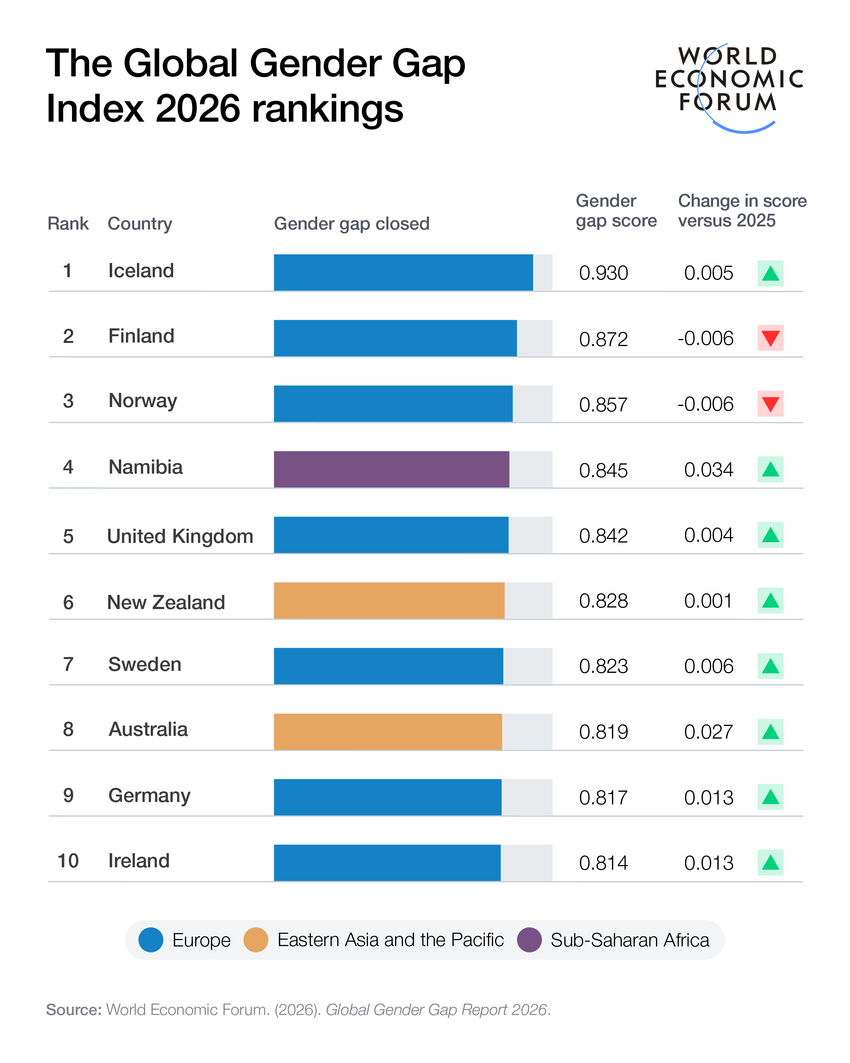
Iceland leads in the report's rankings for the 17th consecutive year, with 93% of the gender gap closed, and remains the only country to have closed more than 90% of its gap. Finland (87.2%) and Norway (85.7%) hold second and third for the third year running. Namibia (84.5%) climbed four places to fourth, the highest-ranked country in Sub-Saharan Africa, followed by the United Kingdom (84.2%), New Zealand (82.8%), Sweden (82.3%), Australia (81.9%), Germany (81.7%) and Ireland (81.4%).
Australia entered the top 10 for the first time. Four economies have appeared in every top 10 since 2006: Iceland, Finland, Norway and Sweden.
Progress has come in phases. Improvement peaked before the pandemic, when 76% of tracked economies recorded gains, before widespread setbacks. Since 2024, more than half of indexed economies have regained momentum. The biggest climbers in this year's ranking are Kenya (65th, up 33 places), Ghana (56th, up 32), Guatemala (50th, up 31), Angola (87th, up 30) and Czechia (77th, up 25).
The economies that have progressed the most in closing their gender gaps since 2006, each closing at least 12 percentage points of their gap, are Bolivia, Chile, Ecuador, France, Guatemala, Iceland, Mexico, Namibia and Nepal.
Biggest gains, clearest reversal
Nearly every economy tracked since 2006 has improved, and the first decade of the index delivered faster gains than the second. Political empowerment has gained the most ground in the last 20 years, up 8 percentage points among the economies tracked throughout. In 2006, there was one woman minister for every 8.1 men; today it is one for every 4.3. In parliaments, the ratio has moved from one woman for every 5.6 men to one for every three or so.
But political empowerment is also the dimension showing the clearest signs of reversal. It now scores lower than it did in 2016 and slipped a further 0.4 percentage points in the past year. At the very top, the share of economies – in the report’s constant sample of 97 economies – led by a woman head of state peaked at 27% in 2022, the highest in half a century, and has since fallen back to 2016 levels, erasing the gains made in the first part of the decade.